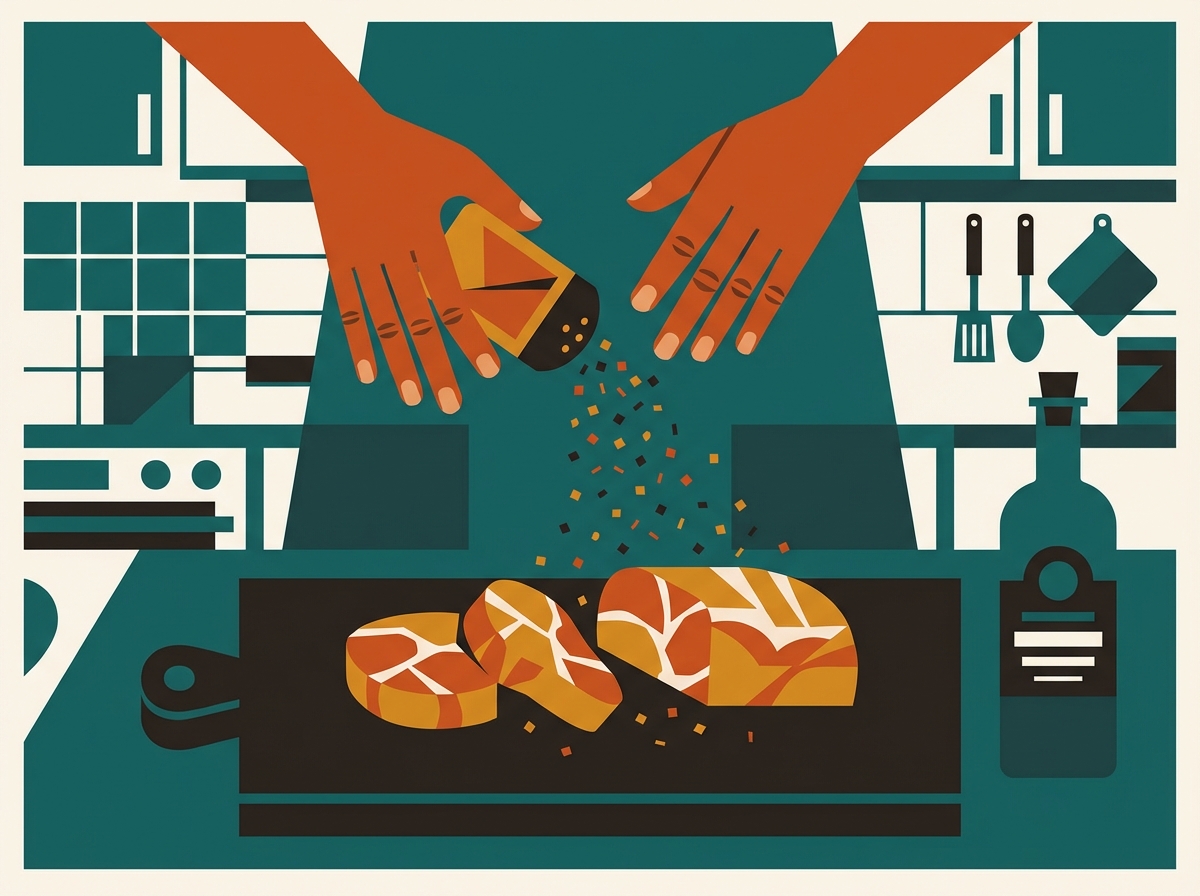
Stovetop Seared Steak
A steak seared over high heat with a deep brown crust and juicy interior — the classic technique in 15 minutes.

Steps
- 01
Pat the steaks dry with paper towels. Season generously on both sides with salt and black pepper.
- 02
Heat a heavy pan over high heat until very hot. Add the oil, then lay the steaks in the pan. Do not move them — sear for 3 to 4 minutes until a deep brown crust forms.
- 03
Flip the steaks. Add the butter, garlic, and rosemary to the pan. Tilt the pan slightly and baste the steaks continuously with the foaming butter for 2 to 3 minutes.
- 04
Transfer the steaks to a plate and rest for 5 minutes. Slice against the grain and serve.
Why it worksHow do I get a proper sear on the stovetop?
How do I get a proper sear on the stovetop?
A proper sear requires three things: a dry surface so water doesn't interfere with browning, a pan hot enough to stay above 140°C when cold food hits it, and fat with a high smoke point to transfer heat evenly. The Maillard reaction that creates the crust only starts above 140°C — moisture keeps the surface temperature stuck at 100°C until it evaporates.
Read the full article →Why it worksWhat is the Maillard reaction?
What is the Maillard reaction?
The Maillard reaction is a chemical reaction between amino acids and sugars that occurs at temperatures above 140°C (280°F). It creates the brown color, complex flavors, and aromas you associate with seared meat, toasted bread, and roasted vegetables. It's not caramelization — that's sugar-only.
Read the full article →Why it worksWhy does my gas burner cook differently from electric or induction?
Why does my gas burner cook differently from electric or induction?
Gas heats through radiant heat and convection from the flame, electric coils conduct heat through the pan bottom, and induction generates heat inside the pan itself via electromagnetic fields. These differences mean gas responds fastest to adjustments, electric holds steady heat, and induction is the most precise and efficient of all three.
Read the full article →Why it worksWhy is it important to rest meat after cooking?
Why is it important to rest meat after cooking?
Resting meat after cooking keeps it juicy when you slice it. Heat tightens muscle fibers and forces moisture toward the center; resting lets those fibers relax and reabsorb that moisture before it runs out onto the cutting board. Internal temperature also continues rising 2–5°C after you pull the meat, so resting is when the last of the cooking happens.
Read the full article →SubstitutionsSubstitutions
Substitutions
- butter→coconut oil×1
Direct replacement. Adds slight coconut flavor.
- butter→olive oil×0.75
Use 3/4 the amount. Changes texture, less rich. Works for cooking, not for baking.